
Indexed Universal Life Insurance: Upside Potential and Downside Protection
Most people know that life insurance provides a death benefit when you die.
But permanent life insurance also offers the potential to grow the value of your policy, as well as downside protection. With indexed universal life insurance, the potential cash value growth is based, in part on the performance of a market index (e.g., the S&P® 500).
All our indexed universal life insurance product offer a zero percent floor—the least interest you are ever credited is 0%. That means that when a chosen market index goes down, your policy’s cash value is protected from losses due to that decline.1
If you need death benefit protection and are interested in growing the cash value of your policy without market risk, indexed universal life insurance may be worth considering.
Key things to know about the upside potential and downside protection offered by indexed universal life insurance:
- The potential growth of the cash value of an indexed universal life insurance policy is based in part on the performance of a market index like the S&P 500 2 or on a fixed interest rate.
- You typically have a choice of multiple crediting strategies.
- Indexed universal life insurance policies aren't directly invested in a market index.
- Caps and participation rates are important factors in determining how much interest is credited when the market goes up.
- Indexed universal life insurance offers protection and a zero percent floor when the market goes down.
What is the upside potential of indexed universal life insurance?
The potential growth of an indexed universal life insurance policy is based in part on the performance of a market index in a given period (usually over a one- or two-year period).
A well-known example of a market index is the S&P 500, which includes a representative sample of the 500 largest companies in leading industries of the U.S. economy.
Indexed universal life insurance typically offers a choice of interest crediting strategies based on different market indexes.
Which index strategy should I choose?
That is up to you! No one can predict how the market will perform—just because a strategy performed a certain way in the past, doesn’t mean it will perform that way in the future. You can also pick more than one strategy. However, remember that diversification does not assure a better return and past performance is no guarantee of future results.
What if I am worried about having just an annual crediting anniversary?
You have the option to spread your premiums over 12 months, using the Systematic Allocation Rider.
Spreading out your premium over a 12-month period helps capitalize on more potential interest rate crediting dates and reduces risk associated with one annual crediting anniversary. However, this does not guarantee better outcomes.
Until allocated into a monthly crediting strategy, premiums will earn interest in a fixed interest crediting account.
Can I change strategies?
Yes, you can change index strategies at any time. Your new strategies will take effect at the start of the next crediting period. You can change your allocations using the National Life Group customer portal or via our app.
DOWNLOAD THE CUSTOMER APP


Will my policy value grow as much as when I invest directly in the stock market?
Not necessarily. How much interest you are credited depends not just on the performance of the chosen market index, but also on the participation rate and whether there is a cap.
What is a cap?
The cap determines the maximum interest you can earn in a period. For example, if the chosen index grows by 10% but your cap is 6%, your policy will be credited with 6% interest.
Not all index strategies are capped.
What is the participation rate?
The participation rate determines how much of the market index gains are credited to your policy.
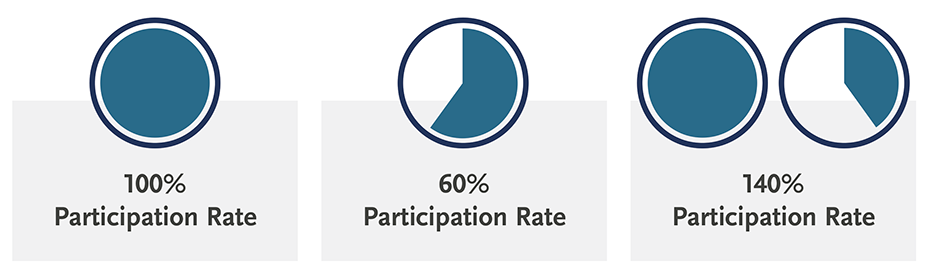
Here are hypothetical examples illustrating how interest is credited for a specific time period (known as “point to point”), which can be one or two years:
- If the market index gained 8.00% and the participation rate is 140%, you would get credited 11.20% if there is no cap.
- If the market index gained 8.00% and the participation rate is 60%, you would get credited 4.80% if there is no cap.
- The participation rate can also be 100%. In that case, you would get credited at the same rate as the market index gain if there is no cap.
What is the downside protection of indexed universal life insurance?
When a chosen market index goes down, you are protected from loss due to that decrease. All our indexed universal life insurance products offer a zero percent floor—the least interest you are ever credited is 0%.
Next step?
- Find out what is best for you and your unique situation: Work with your agent or a financial/tax professional.
National Life Group® is a trade name of National Life Insurance Company, Montpelier, VT, Life Insurance Company of the Southwest, Addison, TX, and their affiliates. Each company is solely responsible for its own financial condition and contractual obligations. Life Insurance Company of the Southwest is not an authorized insurer in NY and does not conduct insurance business in NY.
All guarantees and benefits of the insurance policy are subject to the claims-paying ability of the issuing insurance company. They are not backed by the broker-dealer and/or insurance agency selling the policy, or any affiliates of those entities other than the issuing company affiliates, and none makes any representations or guarantees regarding the claims-paying ability of the issuer.
1 An Indexed Universal Life (IUL) insurance policy is usually a fixed universal life (UL) policy whose interest is determined, at least in part, by the performance of a specified index of the market. Unlike traditional UL policies, the policy owner may receive zero interest for a single crediting period if the index performs poorly. However, with most designs, the premiums are protected and guaranteed to credit a minimum interest rate in the event the policy is surrendered. The owner of an IUL policy may experience better interest crediting than a traditional UL policy during periods when the market performs well. IUL policies do not directly participate in any stock or equity investments. The amount of interest credited is limited by a “cap”. The 0% floor provided by an IUL policy ensures that during crediting periods where the index is negative, that no less than 0% interest is credited to the index strategy. However, monthly deductions continue to be taken from the account value, including a monthly policy fee, monthly expense charge, cost of insurance charge, and applicable rider charges, regardless of interest crediting.
2 The “S&P 500” is a product of S&P Dow Jones Indices LLC or its affiliates (“SPDJI”) and S&P Opco, LLC and has been licensed for use by Life Insurance Company of the Southwest (LSW) and National Life Insurance Company (NLIC). Standard & Poor’s® and S&P® are registered trademarks of Standard & Poor’s Financial Services LLC (“S&P”) and Dow Jones® is a registered trademark of Dow Jones Trademark Holdings LLC (‘’Dow Jones”). The trademarks have been licensed to SPDJI and have been sublicensed for use for certain purposes by LSW and NLIC. The indexed flexible premium adjustable life insurance policy ("the Policy") is not sponsored, endorsed, sold or promoted by SPDJI, Dow Jones, S&P, any of their respective affiliates (collectively, “S&P Dow Jones Indices”). Neither S&P Dow Jones Indices nor S&P Opco, LLC make any representation or warranty, express or implied, to the owners of the IUL product or any member of the public regarding the advisability of investing in securities generally or in FlexLife particularly or the ability of the S&P 500 to track general market performance. S&P Dow Jones Indices and S&P Opco, LLC’s only relationship to LSW and NLIC with respect to the S&P 500 is the licensing of the Index and certain trademarks, service marks and/or trade names of S&P Dow Jones Indices and/or its licensors. The S&P 500 is determined, composed and calculated by S&P Dow Jones Indices or S&P Opco, LLC without regard to LSW and NLIC or the IUL product. S&P Dow Jones Indices and S&P Opco, LLC have no obligation to take the needs of LSW and NLIC or the owners of the Policy into consideration in determining, composing or calculating the S&P 500. Neither S&P Dow Jones Indices nor S&P Opco, LLC are responsible for and have not participated in the determination of the prices, and amount of FlexLife or the timing of the issuance or sale of the Policy or in the determination or calculation of the equation by which FlexLife is to be converted into cash, surrendered or redeemed, as the case may be. S&P Dow Jones Indices and S&P Opco, LLC have no obligation or liability in connection with the administration, marketing or trading of the Policy. There is no assurance that investment products based on the S&P 500 will accurately track index performance or provide positive investment returns. S&P Dow Jones Indices LLC is not an investment advisor. Inclusion of a security within an index is not a recommendation by S&P Dow Jones Indices to buy, sell, or hold such security, nor is it considered to be investment advice. NEITHER S&P DOW JONES INDICES NOR S&P OPCO, LLC GUARANTEES THE ADEQUACY, ACCURACY, TIMELINESS AND/OR THE COMPLETENESS OF THE S&P 500 OR ANY DATA RELATED THERETO OR ANY COMMUNICATION, INCLUDING BUT NOT LIMITED TO, ORAL OR WRITTEN COMMUNICATION (INCLUDING ELECTRONIC COMMUNICATIONS) WITH RESPECT THERETO. S&P DOW JONES INDICES AND S&P OPCO, LLC SHALL NOT BE SUBJECT TO ANY DAMAGES OR LIABILITY FOR ANY ERRORS, OMISSIONS, OR DELAYS THEREIN. S&P DOW JONES INDICES AND S&P OPCO, LLC MAKES NO EXPRESS OR IMPLIED WARRANTIES, AND EXPRESSLY DISCLAIMS ALL WARRANTIES, OF MERCHANTABILITY OR FITNESS FOR A PARTICULAR PURPOSE OR USE OR AS TO RESULTS TO BE OBTAINED BY NLIC, OWNERS OF THE FLEXLIFE PRODUCT, OR ANY OTHER PERSON OR ENTITY FROM THE USE OF THE S&P 500 OR WITH RESPECT TO ANY DATA RELATED THERETO. WITHOUT LIMITING ANY OF THE FOREGOING, IN NO EVENT WHATSOEVER SHALL S&P DOW JONES INDICES OR S&P OPCO, LLC BE LIABLE FOR ANY INDIRECT, SPECIAL, INCIDENTAL, PUNITIVE, OR CONSEQUENTIAL DAMAGES INCLUDING BUT NOT LIMITED TO, LOSS OF PROFITS, TRADING LOSSES, LOST TIME OR GOODWILL, EVEN IF THEY HAVE BEEN ADVISED OF THE POSSIBILITY OF SUCH DAMAGES, WHETHER IN CONTRACT, TORT, STRICT LIABILITY, OR OTHERWISE. THERE ARE NO THIRD PARTY BENEFICIARIES OF ANY AGREEMENTS OR ARRANGEMENTS BETWEEN S&P DOW JONES INDICES AND NLIC, OTHER THAN THE LICENSORS OF S&P DOW JONES INDICES.
Indexed Universal Life Insurance Products including: LSW FlexLife, Form Series 20608(0119)/ICC19-20608(0119). FlexLife, NY Form Series 20607(0119)/20658(0119). Living Life Defender, Form Series 20608(0119)/ ICC19-20608(0119). RapidProtect, Form Series. 20608(0119)/ ICC19-20608(0119). RapidProtect NL, Form Series 20607(0119)/ ICC19-20607(0119). SummitLife, Form Series 20608(0119)/ICC19-20608(0119). SurvivorLIfe, Form Series 20678(0220)/ICC20-20678(0220). SurvivorLife NL, Form Series 20677(0220)/ICC20-20677(0220). Systematic Allocation Rider, Form Series 20431(0616)/ICC16-20431(0616), 20411(0616)/ICC16-20411(0616).
TC9038511(0726)3